
德文·斯塔科尼斯:12年追光,在观澜“刮”出世界
德文·斯塔科尼斯:12年追光,在观澜“刮”出世界
Devon Stackonis: Chasing Light for 12 Years, Scraping a World into View in Guanlan
文 | 粟月兰 杨紫涵
译 | 管欣玥
图 | 朱亚文
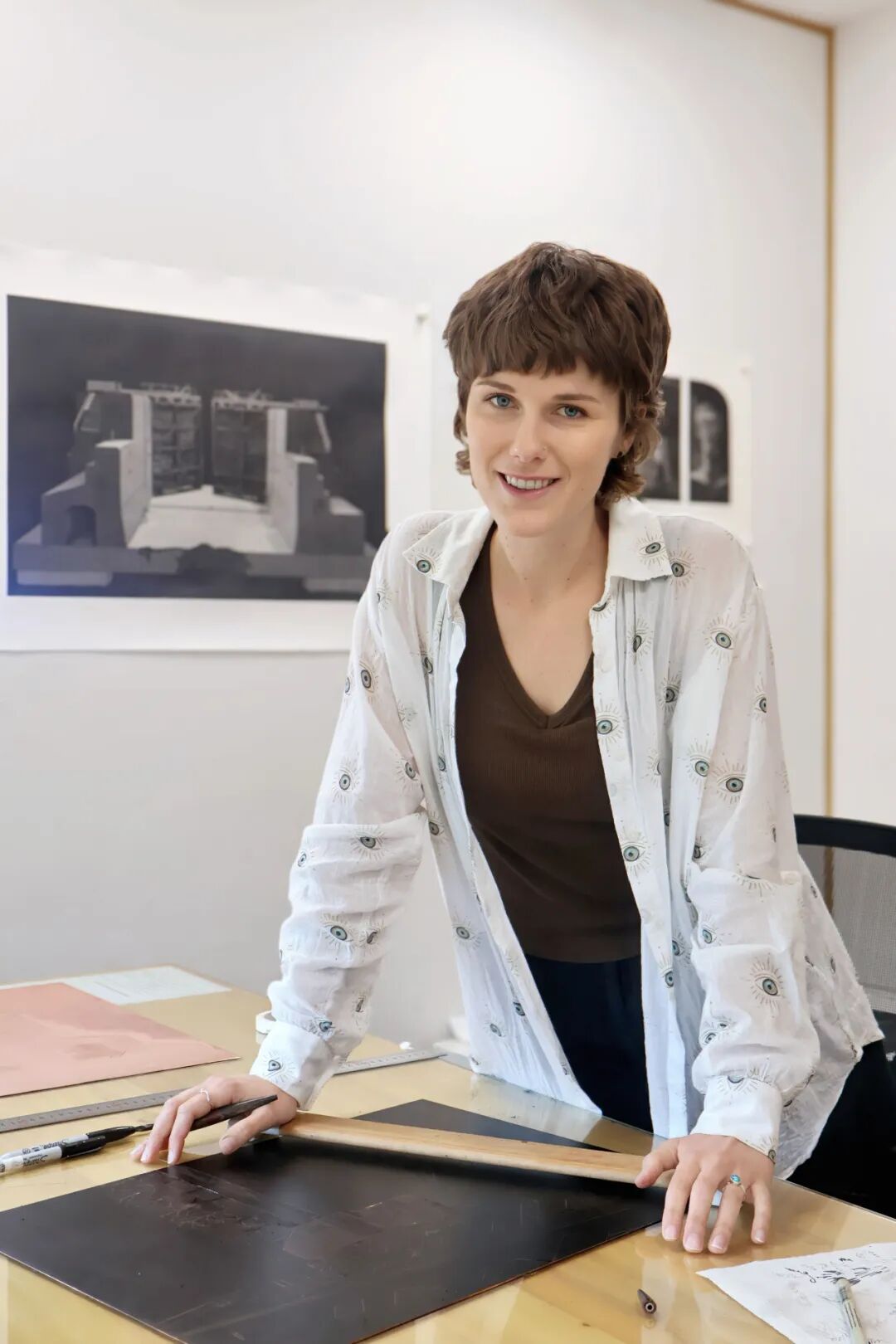
△德文·斯塔科尼斯:美国版画艺术家,普林斯顿大学毕业后,跨越12年追光之旅来到深圳观澜版画基地。在客家古村落与现代都市的对话中,她以“减法”创作,寻找自然与人造结构的微妙平衡。
△Devon Stakonis: An American printmaking artist. After graduating from Princeton University, she came to the Guanlan Printmaking Base in Shenzhen at the end of a 12-year journey chasing the light. In the dialogue between ancient Hakka villages and the modern city, she creates by "subtraction", searching for the delicate balance between nature and man-made structures.

德文·斯塔科尼斯(Devon Stackonis)第一次听说观澜版画基地时,还是个刚爱上版画的大学生。在普林斯顿大学画室的地下室里,她在铜板上刻下第一道痕迹。“这个地方,我在心里放了12年。”直到12年后,她终于站在了深圳观澜的客家村落里。“我不敢相信我真的在这里。”
When Devon Stackonis first heard about the Guanlan Printmaking Base, she was a university student who had only just fallen in love with printmaking. In the basement of a studio at Princeton University, she made her first mark on a copper plate. “I kept this place in my mind for 12 years.” It was not until 12 years later that she finally stood in a Hakka village in Guanlan, Shenzhen. “I can’t believe I’m really here.”
第一次抵达深圳时,她就被眼前的城市震撼了。“我从来没有见过这样的大都市,也从来没有见过这么多的高楼大厦。”在她看来,深圳与她曾经生活过的城市都不一样——建筑密集而现代,城市向远处铺展开去,仿佛没有尽头。
When she first arrived in Shenzhen, the sight of the city stunned her. “I had never seen a metropolis like this, or so many skyscrapers.” To her, Shenzhen was unlike any city she had lived in before: its architecture was dense and modern, and the city stretched into the distance as though it had no end.
但真正让她着迷的,是观澜版画基地的景象。基地位于客家村落之中,古老的建筑、斑驳的墙壁,与城市拔地而起的高楼形成鲜明对照。“当我从这里去往城市,再回到基地,回到这些古老的建筑周围时,总会感到非常平静。”
What truly captivated her, however, was the Guanlan Printmaking Base. Set within a Hakka village, its old buildings and weathered walls stand in stark contrast to the high-rises springing up across the city. “Whenever I go from here into the city and then return to the base, back among these old buildings, I always feel very peaceful.”
那些墙壁尤其吸引她。“它们显示着时间的记录,墙上的痕迹也像是一种记忆。”而这,恰好与她多年来的创作不谋而合:在自然环境与人造结构之间,寻找一种彼此牵引、彼此对话的关系。
Those walls held a particular fascination for her. “They bear the record of time; the marks on them are like a form of memory.” This closely echoed the direction of her work over the years: searching for a relationship between natural environments and human-made structures, each exerting a pull on and entering into dialogue with the other.
德文最初学习油画。本科就读于普林斯顿大学期间,她在伊凡·萨默尔教授的指导下接触到第一堂版画课。“我去学校学习油画,但后来爱上了版画制作过程,从那以后,我开始从事版画创作。”
Devon initially studied oil painting. While an undergraduate at Princeton University, she took her first printmaking class under the guidance of Professor Evan Summer. “I went to school to study oil painting, but then I fell in love with the printmaking process. I have been making prints ever since.”
她尤其钟情于美柔汀——一种复杂、缓慢,却极具沉静力量的铜版技法。创作者先将铜板表面处理成能够承载浓重黑色的底面,再用刮刀、抛光器等工具一点点刮除、磨亮,令图像从黑暗中显现出来。
She was particularly drawn to mezzotint—a complex, painstaking copperplate technique with an immense quiet power. The artist first prepares the surface of a copper plate so that it will print a rich, dense black, then uses a scraper, burnisher, and other tools to scrape away and polish the surface little by little, bringing the image out of the darkness.
“它非常耗时,但也非常适合冥想。”德文说,在这个快速运转的世界里,人们接触大量媒介,消费海量信息,而美柔汀迫使她慢下来。“每一个痕迹,都是我自己与表面接触的产物。”创作时,她有时间思考下一步,也有时间思考更远的地方。
“It is extremely time-consuming, but also highly meditative,” Devon said. In a fast-moving world, people engage with a wide range of media and consume vast quantities of information, whereas mezzotint forces her to slow down. “Every mark is the product of my own contact with the surface.” As she works, she has time to consider her next step—and time to think about more distant places.
她把这种过程称为“减法”,也叫作“用光画画”——先拥有一整块浓密、如天鹅绒般的黑,再从黑色中刮出图像,光便一点点浮现出来。“我觉得它非常诗意。”
She describes the process as “subtractive” and “painting with light”: one begins with a whole field of dense, velvety black, then scrapes the image out of it as the light gradually emerges. “I find it very poetic.”
驻留期间,她每天在工作室里创作,也不断被身边的人和作品激励着。“我觉得每天走过这里的一众版画工作室,都会看到我一生中见过的最好的版画,而且这件事每天都在发生。”技术人员的工作、共同创作的艺术家,以及不同国家之间的交流,都让她感到震撼。
During her residency, she worked in the studio every day and was continually spurred on by the people and works around her. “I feel that every day I walk through the printmaking studios here, I see the finest prints I have ever seen in my life—and this happens every day.” The work of the technicians, the fellow artists creating alongside her, and the exchanges among people from different countries all left a deep impression on her.
谈及即将到来的深圳APEC,德文坦言,她正计划为APEC相关展览和交流创作一幅作品,灵感可以来自深圳的高楼大厦,也可能是客家村落里的屋顶和墙面、基地中的碉楼。在她看来,碉楼就像塔一样,而塔一直是她反复描绘的对象,它们带有“观看或被观看”的意味,像是某种无声的交流。
With APEC coming to Shenzhen, Devon said she was planning to create a work for related exhibitions and exchanges. Her inspiration might come from Shenzhen’s skyscrapers, or perhaps from the rooftops and walls of the Hakka village and the diaolou at the Guanlan Printmaking Base. To her, the diaolou have the presence of towers, and towers have long been recurring subjects in her work. They carry a sense of “watching or being watched”, like a form of silent communication.
但她并不想只描绘建筑。“我想寻找自然环境和建筑环境之间的推拉关系。”鸟、蜗牛,以及那些她叫不出名字的植物和蔬菜,也都成为她的观察对象。“我每天在盘子里看到一些一生中从未见过的蔬菜。”她希望在作品中呈现自然与人造结构交叠的层次,呈现建筑所承载的岁月,也礼赞这里丰富而陌生的生命。
But she does not want to depict architecture alone. “I want to explore the push and pull between the natural and built environments.” Birds, snails, and plants and vegetables whose names she does not know have all become subjects of her observation. “Every day, I see vegetables on my plate that I have never seen in my life.” In her work, she hopes to convey the layers formed where nature and human-made structures overlap and the passage of time borne by the architecture, while celebrating the rich and unfamiliar life she has found here.
“我不是本地人,我是客人。”面对深圳这片并不属于自己的土地,德文始终保持着一份客人的自觉,希望以适当而感激的方式,向这个地方致意。
“I am not a local. I am a guest.” On this land in Shenzhen that is not her own, Devon remains conscious of her place as a guest, hoping to pay tribute to it in a fitting way and with gratitude.
她想起泰国版画家到访时的情景:中国艺术家、泰国艺术家和来自不同国家的驻留艺术家,在同一个房间里观看作品,交流各自使用的工艺。“我们都在以某种方式交流,就作品进行对话。”那一刻,她深切感到,材料和技法也可以成为一种共同语言。“版画真正美丽的地方,就在于它是一种交流形式。”一件作品可以被印制成许多份,最终散落到不同地方,去往哪里,往往取决于命运和偶然。
She recalled a visit by printmakers from Thailand: Chinese artists, Thai artists, and resident artists from different countries gathered in the same room to view the works and discuss their respective processes. “We were all communicating in some way, entering into dialogue through the work.” At that moment, she felt deeply that materials and techniques, too, could become a shared language. “The real beauty of printmaking is that it is a form of communication.” A single image can be printed in multiple impressions, which ultimately make their way to different places. Where they end up often depends on fate and chance.
在美柔汀深沉的黑色里,光不是被直接画上去的,而是经过漫长等待与一点点刮磨,才逐渐显现。德文的艺术之路,也像这样——从普林斯顿画室地下室的第一次注视开始,辗转美国、波兰与中国,到如今在深圳观澜古村;经过跨越12年的追光旅程,她终于用一把刮刀,从黑色里刮出了一个属于深圳、也属于整个亚太的世界。
In the deep black of mezzotint, light is not drawn on directly. It emerges only after a long wait and patient, incremental scraping and burnishing. Devon’s artistic journey has unfolded in much the same way—from that first gaze in the basement of a Princeton studio, through the United States, Poland, and China, and now to the old village of Guanlan in Shenzhen. After a 12-year journey in pursuit of light, she has finally used a scraper to draw from the black a world belonging both to Shenzhen and to the Asia-Pacific as a whole.
-End-
原标题:《德文·斯塔科尼斯:12年追光,在观澜“刮”出世界》