赵小勇:花了29年,才有了“梵高与我”
赵小勇:花了29年,才有了“梵高与我”
Zhao Xiaoyong: 29 Years to Forge "Van Gogh and Me"
文 | 刘婷芳
译 | 杨紫涵
图 | 唐海圳
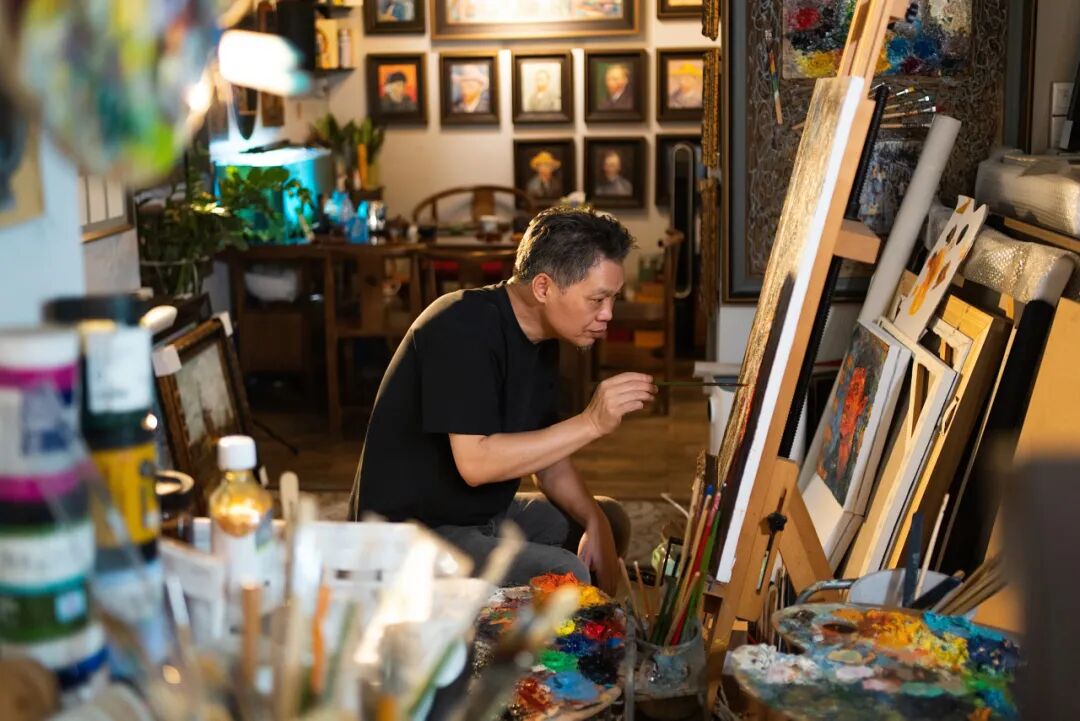
△赵小勇:1997年来到大芬村,十多万幅梵高临摹作品销往欧美。后从临摹转型原创,画出“梵高与我”系列。2025年举办“中国梵高·赵小勇艺术展”个展,完成从画工到画家的蜕变。
△Zhao Xiaoyong: He came to Dafen Village in 1997, and more than 100,000 of his Van Gogh copies were sold to Europe and America. He later turned from copying to original work and painted the "Van Gogh and I" series. In 2025, he held the solo exhibition "Chinese Van Gogh: Zhao Xiaoyong Art Exhibition", completing his change from a painting worker to real artist.

“以前画梵高是订单,现在画梵高是情感。”赵小勇领着访客在工作室穿行,如数家珍地介绍着满墙满地的画作。
“Copying Van Gogh used to be work for orders; now it’s an emotional pursuit.” Zhao Xiaoyong leads visitors through his studio, introducing the paintings covering walls and floors like old friends.
很难想象,眼前这个被称为“中国梵高”、开过个人艺术展的画家,起点不过是湖南邵阳一个连美术课本都没摸过的失学少年。而他走过的二十九年,刚好也是大芬村从“油画车间”蜕变为原创艺术街区的二十九年。
It is hard to imagine that the painter hailed as “China’s Van Gogh”, who has held solo art exhibitions, started out as a school dropout from Shaoyang, Hunan, without even owning an art textbook. The twenty-nine years he has spent here mirror Dafen Oil Painting Village’s transformation from an oil painting workshop cluster into an original art district.
赵小勇是1997年来的大芬。彼时的大芬,是世界名画的临摹品“中国制造”集散地。香港画商把订单带进来,画工们在握手楼里流水作业。赵小勇跟师傅学了半年就敢单干:赊画布,啃泡面,背画去罗湖商业城求人代卖,卖出才结账。
Zhao Xiaoyong arrived in Dafen in 1997. Back then, Dafen was China’s manufacturing hub for world-famous painting replicas. Hong Kong art dealers brought in bulk orders, and painters worked assembly-line style in cramped, closely-spaced residental buildings. After only six months of apprenticeship, Zhao struck out on his own: he bought canvases on credit, survived on instant noodles, and carried his paintings to Luohu Commercial City to find consignment sellers, only getting paid once the works were sold.
“梵高的画是真的好卖。”他从不避讳。1999年,港商一笔临摹梵高画作的订单因耗油多被其他画工师傅拒绝,他接了下来。从此他专画梵高,窗户外挂“专画梵高”的红牌子。那是大芬村黄金的十年,2001年光一幅《鸢尾花》,赵小勇工作室就接单五千张,老婆、小舅子、邵阳老家的堂弟全被他拉上阵。“我弟画向日葵比我还快,二十来分钟一幅,闭着眼都能描。”后来有美院老师跑来大芬,盯着他的存货纳闷:科班出身怎么反倒没你们画得这么“像”?赵小勇答得很直白:“不是像,是画得太熟了。”
“Van Gogh’s paintings sold incredibly well,” he admits candidly. In 1999, a Hong Kong merchant placed an order for Van Gogh replicas that other painters turned down due to high paint consumption—Zhao took the job. From then on, he specialised in Van Gogh, hanging a red sign outside his window reading “Specialising in Van Gogh”. That marked Dafen’s golden decade. In 2001 alone, his studio received five thousand orders for . He brought his wife, brother-in-law, and male cousins from his hometown in Shaoyang to work alongside him. “My younger brother could churn out faster than me—one every twenty minutes, he could paint them blindfolded.” Later, fine arts academy teachers visited Dafen and stared at his stock in confusion, wondering why trained artists could never replicate the works so flawlessly. Zhao gave a straightforward answer: “It’s not that we’re perfect at imitation; we’ve simply painted them thousands of times.”
2008年金融危机一来,香港的单断了,大芬死了一半画坊。也是那年,一个在阿姆斯特丹梵高博物馆旁开店的荷兰画商误打误撞推开他的门,愣了几秒脱口而出:“像走进了梵高博物馆。”五十张试单寄过去,不到一个月越洋电话追回来:全空了。就这样,单还在。十万多幅“赵小勇款梵高”漂洋过海送进了欧美各国的客厅里。
The 2008 global financial crisis cut off all Hong Kong orders, and half of Dafen’s studios folded. That same year, a Dutch art dealer with a shop beside Van Gogh Museum in Amsterdam stumbled into his studio. He froze for a moment and exclaimed, “It’s like walking into Van Gogh Museum.” Fifty trial copies were shipped overseas, and within a month, an overseas phone call confirmed every single piece had sold out. Orders kept flowing in, and over one hundred thousand “Zhao Xiaoyong-style Van Gogh replicas” were shipped to living rooms across Europe and America.
而真正把他从“画工”推向“画家”的,是2014年荷兰行。回忆起站在阿姆斯特丹梵高博物馆的真迹前,赵小勇说自己当时“一下子被震醒了”——临摹了十几年,才发现那些笔触、肌理和自己流水线上的复制品根本不是同一种东西。
Yet it was a trip to the Netherlands in 2014 that turned him from a copy painter into a fine artist. Recalling standing before Van Gogh’s authentic works at Van Gogh Museum in Amsterdam, Zhao said he was utterly shaken. After over a decade of copying, he realised the brushstrokes and textures of his mass-produced replicas bore little resemblance to the master’s originals.
他接着去了法国阿尔勒,在梵高曾经写生的露天咖啡馆里,就地取材,借了一只红酒桶当作画架起笔。“我印象最深刻的是,当时,有一个小女孩,被妈妈牵着手,送了一朵粉玫瑰给我。”回忆到这儿,他有些不好意思地笑了笑。为了留住这幅现场写生的作品,咖啡馆老板还特意邀请赵小勇一行人饮酒小聚。异国晚风里,酒杯相碰的瞬间,他真切觉得,自己临摹了万千次的荷兰画家,好像跨越时间活了过来。
He then travelled to Arles, France, and set up an impromptu easel using a wine barrel at the outdoor cafe where Van Gogh once painted. “One memory stands out most: a little girl, holding her mother’s hand, handed me a pink rose.” He smiles shyly as he recounts the moment. The cafe owner even invited Zhao and his team for drinks to preserve the on-location sketch he’d created. Over wine clinking glasses in the foreign evening breeze, he truly felt the Dutch painter he’d copied thousands of times had crossed time to stand beside him.
回国后,他对老婆说:“我要画原创。”他开始画“梵高与我”:把梵高画进自己大芬村那间老工作室的角落里,画自己提着水果去探望割耳后的梵高……“梵高是我的来路,但不是我的名字。”2018年,纪录片《中国梵高》在海内外热播,赵小勇的工作室涌进各种肤色的人。海外藏家不再只问“像不像”,转而好奇“哪个是你”。2025年1月,“中国梵高:赵小勇艺术展”在深圳南山智谷开幕。展览分两块:前半“遇见梵高”放临摹,后半“我不是梵高”放原创——曾经被叫作“中国梵高”的男人,把自己的名字从这四个字里摘了出来。从输出视觉商品到输出个人艺术叙事,他在不经意间,完成了大芬第一代画工最难的国际化转身。
Upon returning to China, he told his wife: “I want to create original art.” He began painting his series “Van Gogh and I”, depicting Van Gogh lingering in the corner of his old Dafen studio, and scenes of himself bringing fruit to visit Van Gogh after the ear incident. “Van Gogh is where I came from, but he cannot be my identity.” In 2018, the documentary was broadcast worldwide, drawing visitors of all nationalities to his studio. Overseas collectors no longer only asked how faithful his copies were—they began to wonder, “Where is Zhao Xiaoyong in these works?” In January 2025, the art exhibition opened at Nanshan I Valley in Shenzhen. The show was split into two sections: the first, , featured his reproductions; the second, , showcased original creations. The man once labelled “China’s Van Gogh” had finally separated his own name from that title. From manufacturing visual commodities to delivering personal artistic narratives, he completed the most difficult international transformation of Dafen’s first generation of copy painters.
如今的大芬正一点点褪去最后的“行画集散地”旧影子:产业直播、“云逛大芬”等数字传播手段相继落地,AIGC人工智能技术全面进入艺术创作与交易场景,越来越多的本土画家闯进全国美展。赵小勇那句“我不是梵高”,刚好替大芬油画村喊出了最难的那一句。
Today, Dafen is gradually shedding its old identity as a mass replica trading hub. Live-streamed art sales, “Virtual Tours of Dafen”, and AIGC technology have been fully integrated into art creation and trading. More and more local painters have exhibited in national fine arts exhibitions. Zhao Xiaoyong’s line “I am not Van Gogh” perfectly voices what Dafen Oil Painting Village has long struggled to declare.
“前两天我偶然刷到阿尔勒的视频——你看,十二年了,那幅画还挂在最扎眼的位置。”他翻出微信里的视频,轻声笑了笑,眼底满是感慨。
“I chanced upon a video of Arles the other day — twelve years on, that painting still hangs in the most prominent spot,” he scrolls through a video on WeChat and chuckles softly, filled with emotion.
如今他被写进大芬村的推介手册,简介上印着“大芬村之光”。但他还是习惯晚上十点后才进状态。等大芬的画廊打烊、游客散尽,在自家阳台支一张矮桌铺开画布。阿尔勒那家咖啡馆还留着当年的玫瑰与酒渍,而深圳的夜里,赵小勇落下了新的一笔。
His profile now appears in official brochures for Dafen Village, titled “The Light of Dafen”. Still, he prefers to pick up his brush after 10 pm, once Dafen’s galleries close and tourists leave. He sets up a low table on his balcony and unfurls a canvas. The cafe in Arles still holds the faint traces of that rose and wine from years ago, while in Shenzhen’s night, Zhao Xiaoyong lays down a new stroke.
-End-
原标题:《赵小勇:花了29年,才有了“梵高与我”》