
华中农业大学近期科学研究进展

在植物硼营养机制研究方面取得新进展
植物激素在植物生长发育、抵抗生物和非生物胁迫中发挥着重要的调控作用。近日,华中农业大学植物营养生物学团队研究揭示了油菜素甾醇(BRs)和茉莉酸(JA)参与植物响应缺硼胁迫的分子调控机制。
油菜素甾醇(brassinosteroids, BRs)是一类多羟基的甾醇类植物激素,因首先从油菜花粉中发现提取而得名,广泛分布在植物的根、茎、叶片、花、种子和幼嫩的生长组织中,调控植物的生长发育。植物缺硼会严重抑制主根的生长,该团队通过研究分析拟南芥响应缺硼和BR的RNA-seq结果,发现两者共表达的基因数高达45.9%(图1c),且这些共表达的基因大部分呈现相反的表达趋势。与野生型相比,BR的受体突变体bri1-119和bri1-301表现出对低硼胁迫不敏感,而BR信号增强突变体bes1-D对缺硼胁迫则表现出显著高的抗性(图1a)。此外,外源添加24-表油菜素内酯(eBL)能显著缓解根的生长抑制(图1b),而添加BR合成抑制剂BRZ会加重根生长的抑制,且缺硼减少了BES1的核信号,但在缺硼条件下添加eBL则能增加BES1的核信号。进一步研究发现缺硼通过抑制BR合成基因BR6ox1和BR6ox2的表达而减少了油菜素内酯(BL)的合成(图1d)。
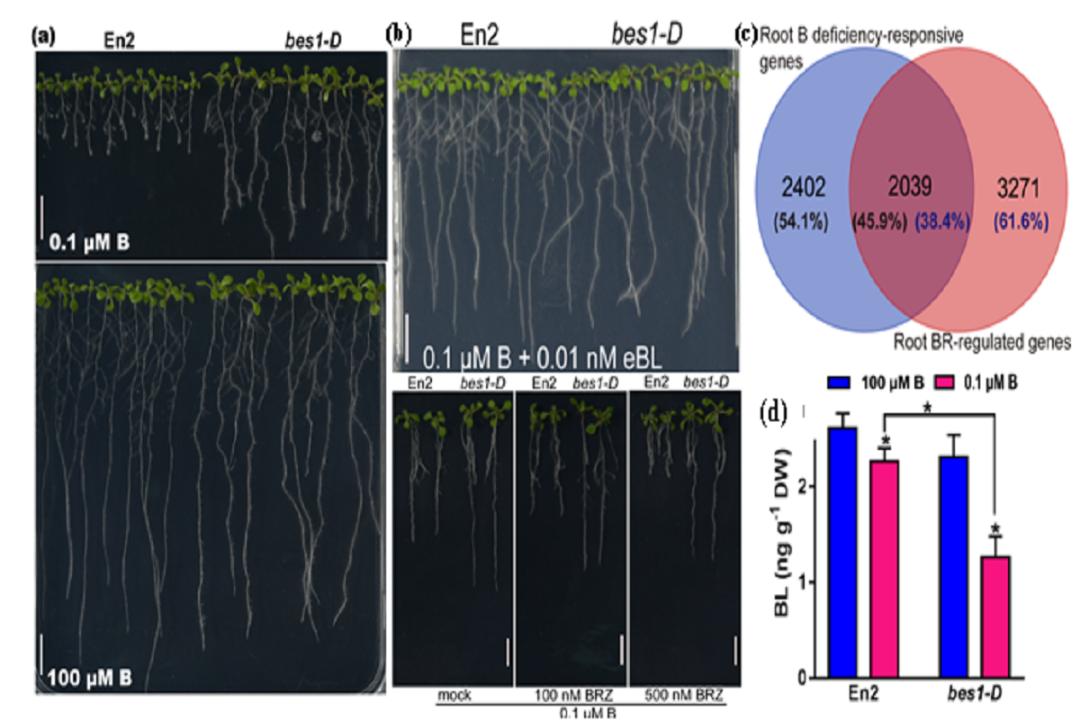 ▲油菜素甾醇(BR)参与拟南芥缺硼胁迫的反应
茉莉酸(JA)是调节植物生长发育、抵御逆境胁迫的一种植物激素。植物营养生物学团队研究发现缺硼条件下拟南芥地上部和根中积累JA达到正常硼条件下的7.9倍和2.8倍,生长受严重抑制,外源添加JA合成抑制剂DIECA则可以缓解缺硼对生长的抑制。团队进一步鉴定到一个缺硼诱导的乙烯转录因子ERF018,通过作用于JA合成基因AOCs的启动子区域,上调了JA合成基因的表达,使JA合成增多。在茉莉酸氨基酸结合酶JAR1的作用下,增多的JA进一步转变为有生物活性形式的茉莉酸-异亮氨酸JA-Ile。JA-Ile与受体复合物SCFCOI1结合激活JA下游信号,参与缺硼对拟南芥生长的抑制。同时,研究发现缺硼上调了乙烯(ET)合成基因的表达,使ET积累,并负调主根生长。JA通过抑制jar1-1突变体中乙烯信号转录因子EIN3的蛋白水平,从而实现JA与ET协同作用于缺硼对主根生长的抑制。JA并不直接调控硼的吸收转运,而是通过影响缺硼时根系构型而影响硼的吸收。
团队成员汪社亮副研究员、王创研究员,丁广大副教授,蔡红梅副教授和石磊教授等参与了研究工作。
【英文摘要】
Brassinosteroids (BRs) are pivotal phytohormones involved in dominating root development. Boron (B) is an essential micronutrient for plants, and root growth is rapidly inhibited under B‐deficiency conditions. However, the mechanisms underlying this inhibition are still unclear. Here, we identified BR‐related processes underlying B deficiency at the physiological, genetic, molecular/cell biological and transcriptomic levels and found strong evidence that B deficiency can affect BR biosynthesis and signalling, thereby altering root growth. RNA sequencing analysis revealed strong co‐regulation between BR‐regulated genes and B deficiency‐responsive genes. We found that the BR receptor mutants bri1‐119 and bri1‐301 were more insensitive to decreased B supply, and the gain‐of function mutants bes1‐D and pBZR1‐bzr1‐D lines exhibited insensitivity to low‐B stress. Under B‐deficiency conditions, exogenous 24‐epibrassinolide (eBL) rescued the inhibition of root growth, and application of the BR biosynthesis inhibitor BRZ exacerbated this inhibitory effect. The nuclear‐localized signal of BES1 was reduced under low‐B conditions compared with B‐sufficiency conditions. We further found that B deficiency hindered the accumulation of brassinolide (BL) to downregulate BR signalling and modulate root elongation, which may occur through a reduction in BR6ox1 and BR6ox2 mRNA levels. Taken together, our results reveal a role of BR signalling in root elongation under B deficiency.
The essential micronutrient boron (B) has key roles in cell wall integrity and B deficiency inhibits plant growth. The role of jasmonic acid (JA) in plant growth inhibition under B deficiency remains unclear. Here, we report that low B elevates JA biosynthesis in Arabidopsis thaliana by inducing the expression of JA biosynthesis genes. Treatment with JA inhibited plant growth and, a JA biosynthesis inhibitor enhanced plant growth, indicating that the JA induced by B deficiency affects plant growth. Furthermore, examination of the JA signaling mutants jasmonate resistant1, coronatine insensitive1‐2, and myc2 showed that JA signaling negatively regulates plant growth under B deficiency. We identified a low‐B responsive transcription factor, ERF018, and used yeast one‐hybrid assays and transient activation assays in Nicotiana benthamiana leaf cells to demonstrate that ERF018 activates the expression of JA biosynthesis genes. ERF018 overexpression (OE) lines displayed stunted growth and up‐regulation of JA biosynthesis genes under normal B conditions, compared to Col‐0 and the difference between ERF018 OE lines and Col‐0 diminished under low B. These results suggest that ERF018 enhances JA biosynthesis and thus negatively regulates plant growth. Taken together, our results highlight the importance of JA in the effect of low B on plant growth.
【论文链接】
https://onlinelibrary.wiley.com/doi/10.1111/tpj.15311
https://academic.oup.com/jxb/article/72/8/3108/6126775
https://onlinelibrary.wiley.com/doi/10.1111/jipb.13048
揭开转座子活动与染色质高级结构进化奥秘
近日,华中农业大学棉花遗传改良团队发表相关研究论文,首次公布了棉属中比四倍体棉花基因组更大的K2基因组,并对A2基因组和D5基因组进行了升级,发现基因组特异的转座子扩增导致了基因组扩张,通过比较三维基因组研究揭示了年轻的转座子扩增伴随着棉属特异的染色质高级结构形成。
棉花(Gossypium)家族成员众多,含有大约52个种,共9种基因组类型,包括二倍体基因组A-G、K和四倍体AD。二倍体棉种染色体数目一致,但基因组大小差异达三倍以上,最大的二倍体基因组K比四倍体基因组AD更大。因此,棉花是研究基因组大小进化的重要资源。该团队前期的研究表明,二倍体A和D基因组在多倍化形成四倍体AD基因组的过程中,伴随着染色质高级结构的重新组织,并对同源基因的表达调控产生影响,但对于转座子活动与染色质高级结构进化之间的关系知之甚少。
本研究利用Nanopore测序技术组装了圆叶棉的基因组(K2),组装大小为2444 Mb;提升了亚洲棉(A2)和雷蒙德氏棉(D5)的基因组,组装大小分别为1621 Mb和750 Mb。重复序列注释表明K2基因组中重复序列占81%,A2占68%,D5占57%。相对于D5,K2和A2中棉种特异的反转录转座子扩增是造成这三个基因组大小三倍变化的原因, 特别是Gypsy和DIRS类型,但转座子扩增对同源基因的位置关系影响较小。全长转座子插入时间分析表明K2基因组中转座子插入最为古老,A2基因组有更多年轻的转座子。
结合染色质互作数据,研究发现三个基因组中17%的共线性同源基因表现为A/B区室的染色质状态改变,这与活跃的转座子扩增相关。相对于D5基因组,在K2和A2基因组转座子的扩增伴随着A区室(活跃)的基因增多。同时,大约60%的拓扑结构域(TAD)在三个基因组中发生了重新组织,特别是K2基因组不保守的TAD边界存在特异的和年轻的转座子插入。基于这些结果,提出了三个棉种分化过程中,基因组扩张-转座子扩增介导的A/B 区室转换和TAD重组的进化模型。
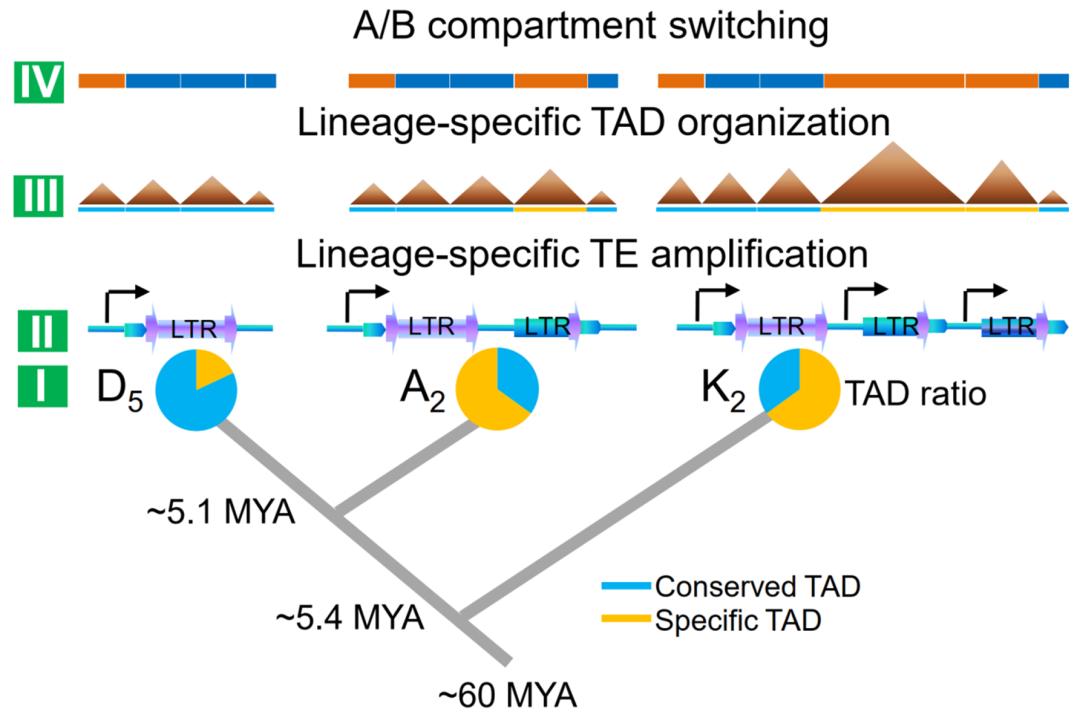 ▲棉花转座子扩增与染色质三维结构进化模型
该研究论文发表于国际学术期刊Molecular Biology and Evolution。华中农业大学王茂军教授和李健英博士为论文共同第一作者,张献龙教授、中国农业科学院棉花研究所王坤波研究员和爱荷华州立大学Jonathan F. Wendel教授为共同通讯作者。
【英文摘要】
Transposable element (TE) amplification has been recognized as a driving force mediating genome size expansion and evolution, but the consequences for shaping 3D genomic architecture remains largely unknown in plants. Here, we report reference-grade genome assemblies for three species of cotton ranging three-fold in genome size, namely Gossypium rotundifolium (K2), G. arboreum (A2), and G. raimondii (D5), using Oxford Nanopore Technologies. Comparative genome analyses document the details of lineage-specific TE amplification contributing to the large genome size differences (K2, 2.44 Gb; A2, 1.62 Gb; D5, 750.19 Mb), and indicate relatively conserved gene content and synteny relationships among genomes. We found that approximately 17% of syntenic genes exhibit chromatin status change between active (“A”) and inactive (“B”) compartments, and TE amplification was associated with the increase of the proportion of A compartment in gene regions (∼ 7,000 genes) in K2 and A2 relative to D5. Only 42% of topologically associating domain (TAD) boundaries were conserved among the three genomes. Our data implicate recent amplification of TEs following formation of lineage-specific TAD boundaries. This study sheds light on the role of transposon-mediated genome expansion in the evolution of higher-order chromatin structure in plants.
【论文链接】
https://doi.org/10.1093/molbev/msab128
揭示叶绿素合成调控的新机制
近日,华中农业大学生命科学技术学院/农业微生物学国家重点实验室微生物光合作用与生物固氮团队端木德强教授课题组揭示了模式生物莱茵衣藻中胆色素分子通过GUN4蛋白调控叶绿素合成的分子机制,拓宽了对叶绿素合成调控的理解,并对探究叶绿体重要信号分子胆色素的更多生物学功能提供了新的见解。相关科研成果发表在在国际学术期刊PNAS上。
光合作用是地球上最重要的化学反应,利用太阳能将环境中的CO2转化为有机物,将光能转化为化学能,是绝大多数生命活动的能量和物质来源。光合微生物被誉为阳光驱动的细胞工厂,供应了超过50%的地球大气层氧气和全球初级生产力,是生物圈物质能量循环的主要原动力。对微生物高光效机理及其精准调控机制的研究是光合作用研究领域的重要创新方向。光合生物通过四吡咯途径合成叶绿素。在叶绿体中,四吡咯前体物质5-氨基乙酰丙酸(ALA)至原卟啉IX(PPIX)处发生分支,形成叶绿素分支和血红素分支。胆色素(BV或PCB)是血红素分支的代谢产物,通常作为光受体光敏素或捕光蛋白藻胆体的生色团,参与光的感知与捕获。在缺乏光敏素和藻胆蛋白的莱茵衣藻中,胆色素作为叶绿体反向信号,缓解光-暗转变过程中产生的氧化胁迫并维持光合自养生长和光合系统I的稳定性。前期研究表明,胆色素的缺乏会影响衣藻细胞叶绿素的积累,但相应分子机制并不清楚。
叶绿素的生物合成受到多方面的调控,其中,ALA合成和镁离子螯合酶(MgCh)是调控叶绿素合成的两个重要节点。MgCh是由CHLH、CHLI和CHLD组成的多亚基复合物,负责叶绿素合成分支第一步反应。GUN4是一种在放氧型光合生物中普遍存在的蛋白,能与MgCh催化亚基CHLH互作并结合其底物和产物,作为MgCh的辅因子激活其活性并参与叶绿素合成调控。
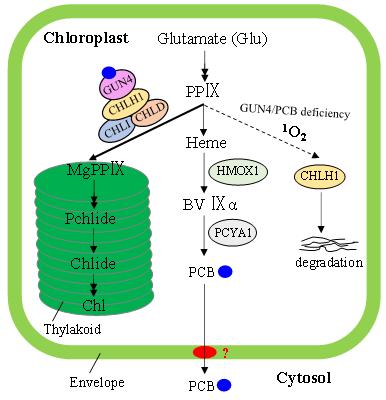 ▲图1 叶绿体信号分子胆色素(PCB)和GUN4调控叶绿素合成的模式图
本研究首先通过光谱分析和蛋白-小分子互作检测等多种生化手段发现衣藻GUN4能与胆色素非共价结合,形成不具有光活化特性及荧光特性的复合物。PPIX具有光敏特性,与GUN4结合之后荧光强度急剧上升,而胆色素PCB则能有效猝灭该荧光(60倍以上)并形成GUN4:PCB:PPIX复合物。体外MgCh活性检测实验表明,在GUN4存在的情况下,胆色素能够显著增加MgCh活性20倍以上。免疫印迹实验显示,GUN4或胆色素的缺乏均会导致衣藻细胞内MgCh催化亚基CHLH1的积累大幅度减少。突变体表型分析表明,GUN4和胆色素的同时缺乏会严重影响衣藻细胞光养生长缺陷表型,使细胞呈现黄棕色。化学互补实验则进一步证实,GUN4和胆色素对于CHLH1蛋白和叶绿素的积累都发挥重要作用。
研究首次揭示了血红素分支产物胆色素与叶绿素分支第一步反应的调控蛋白GUN4互作、促进镁螯合酶MgCh活性及维持MgCh催化亚基CHLH1的稳定性,提出了一种小分子-蛋白(Bilin-GUN4)互作在转录后水平调节叶绿素合成的新型调控机制,并进而提出该调控途径在内共生起源的蓝细菌、真核藻类及高等植物等光合生物中可能普遍存在。该研究不仅丰富了我们对叶绿素合成调控的理解,也为胆色素的多样化且进化上保守的生物学功能研究提供了重要依据。
华中农业大学生命科学技术学院端木德强教授和美国加州大学戴维斯分校J. Clark Lagarias教授为该论文的共同通讯作者,端木德强教授课题组张维清博士为该论文唯一第一作者。本工作ITC实验得到华中农业大学蛋白质平台殷平、张德林老师的协助。
【英文摘要】
Biosynthesis of chlorophyll and heme in oxygenic phototrophs share a common trunk pathway that diverges with insertion of magnesium or iron into the last common intermediate, protoporphyrin IX. Since both tetrapyrroles are pro-oxidants, it is essential that their metabolism is tightly regulated. Here we establish that heme-derived linear tetrapyrroles (bilins) function to stimulate the enzymatic activity of magnesium chelatase (MgCh) via their interaction with GUN4 in the model green alga Chlamydomonas reinhardtii. A key tetrapyrrole-binding component of MgCh found in all oxygenic photosynthetic species, CrGUN4 also stabilizes the bilin-dependent accumulation of protoporphyrin IX-binding CrCHLH1 subunit of MgCh in light-grown C. reinhardtii cells by preventing its photooxidative inactivation. Exogenous application of biliverdin IXα reverses the loss of CrCHLH1 in the bilin-deficient heme oxygenase (hmox1) mutant, but not in the gun4 mutant. We propose that these dual regulatory roles of GUN4:bilin complexes are responsible for retention of bilin biosynthesis in all photosynthetic eukaryotes to sustain chlorophyll biosynthesis in an illuminated oxic environment.
论文链接
https://www.pnas.org/content/118/20/e2104443118
文 | 张成 王茂军 张维清
原标题:《华中农业大学近期科学研究进展》