
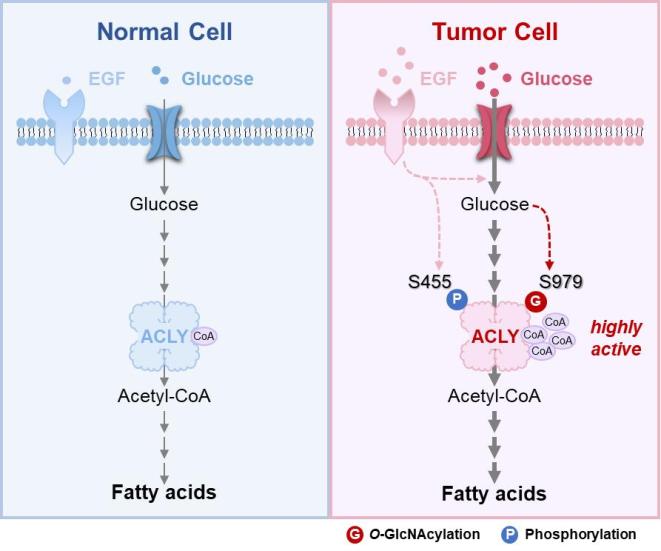
肿瘤细胞的快速增殖和持续分裂依赖膜脂的加倍。因此旺盛的脂质合成被认为是肿瘤细胞代谢的关键特征之一【1-3】。ATP-柠檬酸裂解酶(ATP-citrate lyase, ACLY)是脂肪酸合成代谢途径的第一个关键酶,催化底物柠檬酸与CoA形成脂肪酸从头合成所需的二碳单位乙酰辅酶A。ACLY的表达和活性受到磷酸化、乙酰化和泛素化的调节【4-7】,而近期研究发现,ACLY也可以发生O-GlcNAc糖基化修饰。O-GlcNAc糖基化修饰被广泛认为是一种可以感受营养波动的“sensor”【8-12】,但ACLY的O-GlcNAc糖基化修饰如何感知营养丰度及其生物学意义亟待揭示。
2024年10月10日,东北师范大学分子表观遗传学教育部重点实验室魏民、冯云鹏研究团队在PNAS上发表的题为O-GlcNAcylation of ATP-citrate lyase couples glucose supply to lipogenesis for rapid tumor cell proliferation的研究论文,报道了O-GlcNAc糖基化修饰在ACLY活性调节中的关键作用。
东北师范大学刘佳博士、王杨博士和田苗苗博士为该研究的共同第一作者,冯云鹏教授、魏民教授和金鑫博士为共同通讯作者。浙江大学易文教授、中国科学院杨巍维研究员和复旦大学王永明教授为本论文提供了指导和帮助。
原文链接:
https://doi.org/10.1073/pnas.2402674121
来源:BioArt
参考文献
1. Röhrig F, Schulze A. The multifaceted roles of fatty acid synthesis in cancer. Nat Rev Cancer. 2016. 16(11): 732-749.
2. Snaebjornsson MT, Janaki-Raman S, Schulze A. Greasing the Wheels of the Cancer Machine: The Role of Lipid Metabolism in Cancer. Cell Metab. 2020. 31(1): 62-76.
3. Storck EM, Özbalci C, Eggert US. Lipid Cell Biology: A Focus on Lipids in Cell Division. Annu Rev Biochem. 2018. 87: 839-869.
4. Lin R, Tao R, Gao X, et al. Acetylation stabilizes ATP-citrate lyase to promote lipid biosynthesis and tumor growth. Mol Cell. 2013. 51(4): 506-518.
5. Zhang C, Liu J, Huang G, et al. Cullin3-KLHL25 ubiquitin ligase targets ACLY for degradation to inhibit lipid synthesis and tumor progression. Genes Dev. 2016. 30(17): 1956-70.
6. Lee, JV, et al. Akt-dependent metabolic reprogramming regulates tumor cell histone acetylation. Cell Metab 2014;20:306-319.
7. Icard P, Wu Z, Fournel L, Coquerel A, Lincet H, Alifano M. ATP citrate lyase: A central metabolic enzyme in cancer. Cancer Lett. 2020. 471: 125-134.
8. Bauer DE, Hatzivassiliou G, Zhao F, Andreadis C, Thompson CB. ATP citrate lyase is an important component of cell growth and transformation. Oncogene. 2005. 24(41): 6314-22.
9. Qin W, Lv P, Fan X, et al. Quantitative time-resolved chemoproteomics reveals that stable O-GlcNAc regulates box C/D snoRNP biogenesis. Proc Natl Acad Sci U S A. 2017. 114(33): E6749-E6758.
10. Wang Y, Liu J, Jin X, et al. O-GlcNAcylation destabilizes the active tetrameric PKM2 to promote the Warburg effect. Proc Natl Acad Sci U S A. 2017. 114(52): 13732-13737.
11. Rao X, Duan X, Mao W, et al. O-GlcNAcylation of G6PD promotes the pentose phosphate pathway and tumor growth. Nat Commun. 2015. 6: 8468.
12. Yi W, Clark PM, Mason DE, et al. Phosphofructokinase 1 glycosylation regulates cell growth and metabolism. Science. 2012. 337(6097): 975-80.
13. Guo, D, et al. EGFR signaling through an Akt-SREBP-1-dependent, rapamycin-resistant pathway sensitizes glioblastomas to antilipogenic therapy. Sci Signal 2009;2:ra82.
14. Tomas, A, Futter, CE, Eden, ER. EGF receptor trafficking: consequences for signaling and cancer. Trends Cell Biol 2014;24:26-34.
15. Manning, BD, Toker, A. AKT/PKB Signaling: Navigating the Network. Cell 2017;169:381-405.
16. Potapova, IA, El-Maghrabi, MR, Doronin, SV, Benjamin, WB. Phosphorylation of recombinant human ATP:citrate lyase by cAMP-dependent protein kinase abolishes homotropic allosteric regulation of the enzyme by citrate and increases the enzyme activity. Allosteric activation of ATP:citrate lyase by phosphorylated sugars. Biochemistry 2000;39:1169-1179.
17. Kanao, T, Fukui, T, Atomi, H, Imanaka, T. Kinetic and biochemical analyses on the reaction mechanism of a bacterial ATP-citrate lyase. Eur J Biochem 2002;269:3409-3416.
原标题:《PNAS丨魏民/冯云鹏揭示脂防酸合成关键酶ACLY通过O-GlcNAc糖基化修饰连接葡萄糖供给和脂质合成促进肿瘤细胞增殖》